Cordless Blinds and Child Safety in Fortville Homes

Cordless window coverings get talked about like a safety upgrade you pay extra for, but that's not really how the pricing works anymore. Understanding what you're actually buying, and where the real cost differences show up, makes it a lot easier to plan a budget instead of guessing.
Why a Cord Is More Dangerous Than It Looks
Not all cords carry the same risk, which is where a lot of the confusion starts. A wand that only tilts slats isn't a strangulation hazard by itself, since there's nothing to loop. A continuous loop cord used for lift is a different animal entirely, because the loop already exists before a kid ever touches it. Reading a product label correctly means knowing which kind of cord you're actually looking at, not just whether the word "cord" shows up.
This distinction matters because retailers don't always spell it out clearly on the shelf tag. A Fortville shopper comparing two similar-looking blinds might see "cordless" on one and nothing on the other, when the real difference is whether the lift function uses a loop or a wand, or has no external control at all.
None of this is about assigning blame to a manufacturer either. Terminology in this category has shifted over the past decade, and older packaging simply used looser language than what's standard today. The practical fix stays the same regardless of how something got labeled originally: look at the mechanism, not the sticker.
Making the Blinds You Already Own Safer
If replacing every blind in the house isn't happening this month, there are real interim fixes. A cord cleat mounted high on the frame lets you wind the loop around it and pull it taut, which removes the slack that lets a loop form in the first place. Tension devices anchor the bottom of a continuous loop to the wall or sill so there's no free-hanging loop at all.
Retrofit kits exist for some older blinds too, swapping the cord lock for a cordless clutch without buying a whole new unit, though fit depends on the brand and the headrail's depth. None of this is as reliable as a genuinely cordless product, and a determined toddler can work a cleat loose faster than anyone would like. Treat these as a bridge, not a permanent answer, in any room where a small kid spends real time.
Cords, Cribs, and Furniture Placement
Not every fix here costs money. Moving a crib or a glider away from the window wall is free, and it does as much for safety as anything you'd buy. It's worth doing as soon as you notice the problem, well before new shades ever get ordered or installed.
Cost becomes the deciding factor when the room layout can't change, a small Fortville nursery with only one realistic spot for the crib, for instance. That's when paying for cordless up front instead of grabbing a cheap corded blind on sale makes the better financial sense, since it avoids buying a stopgap now and a replacement later.
It also helps to think about resale timing. A family selling a starter home to another young family is handing off whatever window coverings are already installed, cords included, and a buyer with small kids rarely thinks to ask about it during a walkthrough. Flagging it yourself, or fixing it before listing, is a small thing that matters more than it seems.
What Cordless Really Costs
A nursery is usually one or two windows, which keeps the total manageable even at custom pricing. As a national range, cordless cellular shades for a nursery run about $150 to $450 a window installed, with basic roller shades landing closer to $100 to $350.
Because it's a small room, it's also the easiest place in a Fortville house to justify spending a bit more per window on a better light-filtering or blackout fabric, since the total cost stays reasonable even with a nicer material, and a nursery gets more benefit from good light control than almost any other room.
Two windows in the same nursery don't always need to match exactly either. A window that gets direct morning sun might justify a better blackout fabric, while a second window on a shaded wall can use a simpler light-filtering option at a lower price point, without the room looking mismatched.
If cost is the question holding you back, a free in-home measure from Fortville Window Treatments is the easiest way to get real numbers instead of guessing from a national range online. You'll see stock and custom cordless options side by side and can decide room by room what makes sense this year.
How Cordless Lift Systems Actually Work
Understanding how a cordless mechanism works helps explain why some existing blinds can be converted and others can't. A spring clutch needs enough depth in the headrail to fit, so a shallow older headrail built for a simple cord lock sometimes doesn't have room for the retrofit part, even though the concept is the same.
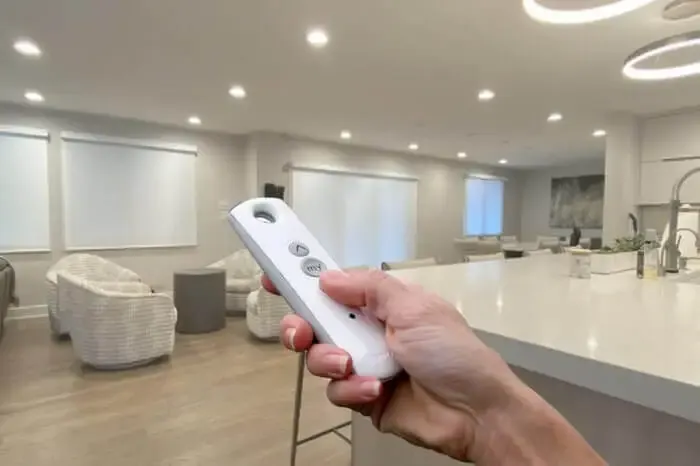
Motorized retrofit kits exist too, adding a battery-powered motor to an existing shade's tube without replacing the whole unit, though this works better on roller and cellular shades than on wood or faux wood blinds, where the tilt mechanism adds complexity a simple motor swap doesn't solve.
Frequently Asked Questions
Are all corded blinds actually dangerous, or just certain types?
The highest risk comes from continuous loop cords, the kind that handle lift and tilt together on a lot of wood and faux wood blinds, because the loop is already formed and just needs to catch on something. A single pull cord with two loose ends is lower risk since there's no pre-formed loop, though it can still be pulled into one if enough cord bunches up. Vertical blinds with a continuous wand-and-cord combination fall into the higher-risk category too. If you're not sure which type is on your windows, checking whether the cord forms a closed loop when you let go of it is the quickest way to tell.
Can I just tie a knot in the cord or cut it shorter myself?
Cutting a cord yourself can void the mechanism's warranty and, depending on the lift system, can actually make the blind stop working correctly if the cord length was set for a reason. Tying a knot doesn't remove the loop risk either, since a kid can still get a hand or head caught in whatever loop remains above the knot. A cord cleat or a proper tension device does the job safely and doesn't touch the blind's internal mechanism, which is why it's the recommended interim step over a DIY cut.
Do I need to replace every blind in the house at once?
No, and most households don't. The priority order that makes sense is a kid's own bedroom and any playroom first, since those are the rooms where a kid spends real unsupervised time near the window. A formal living room or a guest bedroom that a toddler rarely enters can reasonably wait, especially with a cord cleat or tension device in place as an interim measure.
 Battery or Hardwired: Powering Smart Shades in Fortville
 How Custom Drapery Gets Measured and Made Right in Fortville
 What a Proper Measure Catches Before You Buy in Fortville