Battery or Hardwired: Powering Smart Shades in Fortville
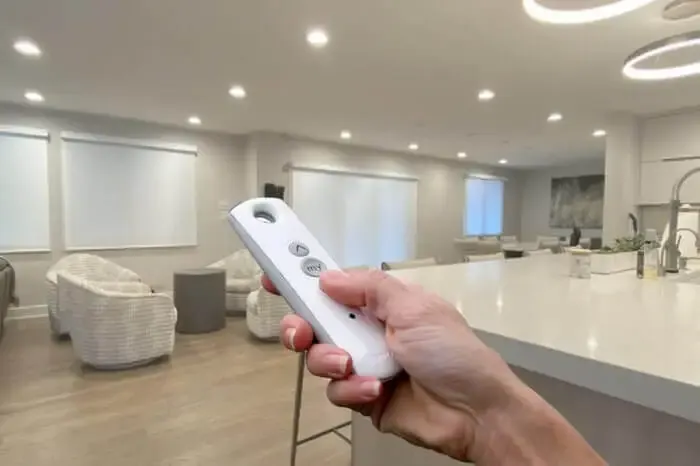
Motorized shades and smart shades get talked about like they're the same thing, and they are not quite. One is a shade with a motor in it. The other adds a layer on top that lets an app or a voice assistant reach that motor. Here is how the pieces actually fit together for a Fortville home.
How Motorized Shades Actually Work
A motorized shade has a small motor built right into the roller tube, spinning the tube to raise or lower the fabric. That motor gets power one of two ways: a rechargeable battery pack that slides into the tube, or a direct hardwired connection to line voltage through a small power adapter. Both work fine, they just trade off differently on convenience versus install complexity.
The motor also needs a way to receive commands, and that's usually a radio signal, not Wi-Fi directly. A handheld remote talks to the motor over that radio link, and that alone makes a shade "motorized." Calling it "smart" usually means something more: a hub plugged into your router that translates between the motor's radio protocol and your home network, so the shade shows up in an app and can respond to a voice assistant.
Skip the hub and you still get remote control, just not app or voice control. That distinction trips people up more than anything else when they're shopping for Fortville smart shades.
Voice Control and the Hub Question
The most common surprise: someone assumes a shade that works with a smartphone app will automatically work with their voice assistant, and those are not the same thing. An app can talk directly to the manufacturer's own cloud service. Getting a voice assistant into that conversation needs a specific integration the manufacturer has to have built and published, and not every brand has built one for every platform.
Another issue: a hub sitting too far from the router, or on the wrong floor of a Fortville home, can drop in and out even though it appeared to set up fine on install day. Wireless range for these hubs is real but limited, and thick walls make it worse.
We've also seen homeowners buy a Z-Wave-based shade assuming it would work with a Zigbee hub they already owned for other devices. The two protocols don't talk to each other without an additional bridge built to translate between them.
What Actually Fails in a Smart Shade System
A large Fortville home with shades spread across multiple floors puts more strain on a single hub than a smaller house does. Signal has to travel further and through more walls, so what works fine in a compact ranch can struggle in a home with a finished basement and a bonus room upstairs.
Rooms far from the router, a detached sunroom or a converted garage, are the most likely to have connectivity trouble first. If a project includes rooms like that, it's worth planning for a second hub or a signal extender from the start rather than waiting to see if it becomes a problem.
Kitchens and rooms with a lot of structural steel or ductwork can also interfere with wireless signal in ways that are hard to predict without just testing it once the shades are actually installed.
Power Planning and Backup Control
Retrofitting hardwired power into a finished wall costs more than planning for it during a remodel, since it means opening drywall and fishing wire through it, then patching everything afterward instead of running a line while the wall is already open. If a Fortville project includes any renovation work, that's the moment to loop in shade wiring even if the shades come later.
A plug-in power adapter avoids that construction cost entirely and is often the more sensible choice for an existing home that isn't otherwise being remodeled, even though it means a small adapter box is visible near the window.
Keypads and extra remotes add a modest cost per unit, but they're worth it as backup control, since losing app access during a router problem is genuinely inconvenient if a physical remote isn't sitting somewhere in the house.
Weighing battery against hardwired, or one ecosystem against another, is easier with actual product in hand rather than a spec sheet. A free in-home measure lets you see and hear a motor running before you commit to a whole-house system.
Battery Life and Charging in the Real World
Ask how the manufacturer rates battery life, and under what conditions. A number like "up to a year" almost always assumes light use, maybe one cycle a day, so ask what that estimate looks like for a wider or more frequently used window specifically.
Ask whether a solar-charging panel is available for that particular motor, and whether it needs full sun or works in partial shade. The answer varies a lot between manufacturers and matters more in a Fortville home with mixed sun exposure across different rooms.
And ask how charging actually works: does the battery tube come out for charging elsewhere, or does a cable plug in while it stays mounted in the window. Some setups are genuinely more convenient than others, and that's worth knowing before installation, not after you're the one climbing a ladder every few months.
Frequently Asked Questions
Should I choose battery or hardwired shades?
It depends on how often the shade will be used and how easy it is to run power to that window. A shade that gets adjusted constantly, or one that is hard to reach for charging, is often a better fit for hardwired. A shade used once or twice a day in an easy-to-reach spot works fine on battery.
Does a solar panel really extend battery life?
It can, but only if it gets real direct sun for a meaningful part of the day. A solar add-on mounted on a shaded or north-facing window will not help much, since it needs consistent light to actually offset what the motor is using.
What should I ask before choosing a smart home hub?
Ask exactly which voice platforms it supports by name, not just whether it is labeled smart home compatible, and ask how it performs at a distance from your router, since range varies by hub. A firmware update's track record with existing schedules and scenes is also worth asking about, since that says a lot about how stable the system actually is.
 How Custom Drapery Gets Measured and Made Right in Fortville
 What a Proper Measure Catches Before You Buy in Fortville
 Window Treatments for a New Fortville Build: A Practical Guide