Retractable Awnings in Fortville by Fortville Window Treatments
Shade for the deck itself, retracted before weather
Answers here cover the whole lifecycle: measuring, ordering, fabrication, installation, care and service. A custom window covering is a long-term purchase and the later stages deserve as much attention as the first.
- Service: Retractable Awnings for Fortville homeowners
- Service area: Fortville, IN and surrounding areas We schedule measures promptly and we're honest about what comes after. Your product is manufactured to your dimensions, which takes weeks rather than days, and that applies to every custom line we sell.
- Insured and bonded
- Serving Fortville, IN since 2008
Expert Retractable Awnings for Fortville Homes
Fortville is adding outdoor living space faster than its housing count suggests. Only 105 of the town's 1,935 units were built in 2020 or later, but five builders are actively selling here and 138 acres west of Deaton's Business Park were annexed in January 2026, so the patio count is climbing well ahead of the census. A retractable awning suits the rear elevations those plats produce: no mature canopy, since the post-1990 subdivisions were built on cleared Vernon Township farm ground, and a west or south exposure with nothing in front of it. On a Geist facing deck it does what no interior product can, which is shade the deck itself.
An awning is a structure and it fails like one. Wind is the hazard, and the honest advice is that a retractable awning is a fair weather device: retract it when you leave and retract it when the sky changes, whether or not a wind sensor is fitted. Never leave one extended through a Fortville winter, when the January average high is 36.1 degrees and wet snow load on the fabric is far beyond what the arms carry. Fabric also shifts color over years of sun, and a replaced panel next to an original one will show it. National installed pricing runs roughly $1,000 to $6,000, and fabrication takes 2 to 5 weeks.
Signs You Need Retractable Awnings
If you notice any of these in your Fortville home, it is worth booking a measure. None of it is urgent, and none of it fixes itself either.
A deck faces west with no cover at all
An old awning frame is bent from wind
Birds have built inside the awning housing
A fixed cover would darken the room behind it
Nobody remembers to bring it in before a storm
Water pools in the middle of an old canopy
Mornings on the patio are fine, afternoons are not
The patio door lets heat into the room behind it
The canopy fabric is shot but the arms still work
Afternoon sun pours through a sliding door
How Fortville Window Treatments Handles Retractable Awnings
Every job follows the same five-step process. Transparent, thorough, and done right the first time.
Patio measured, shadow path traced
Wind sensor specified
Written scope, dates and price
Brackets anchored, awning hung
Pitch set, wind routine explained
Retractable Awnings in Fortville
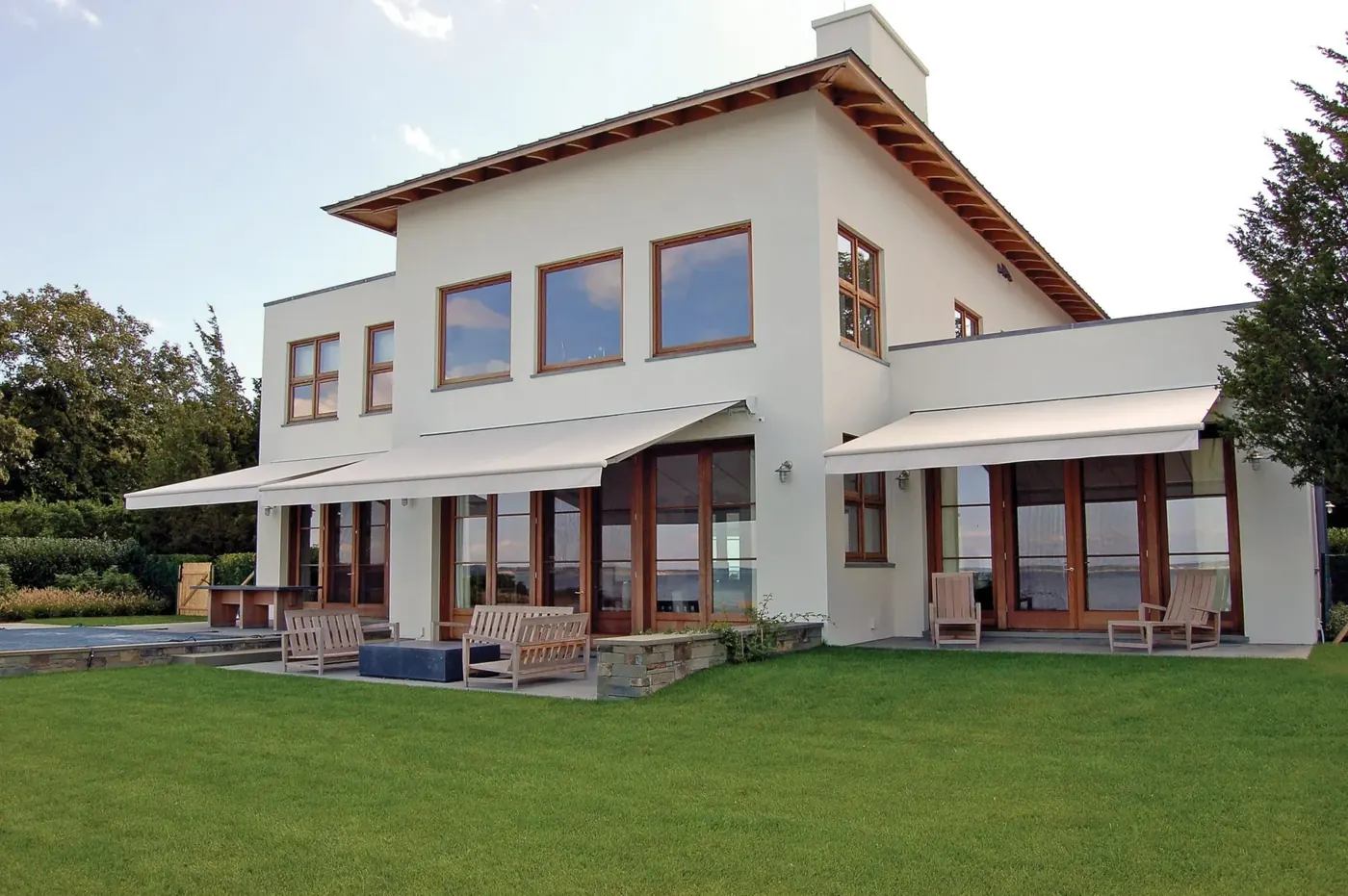
Photographs from real retractable awnings jobs completed by our crew in Fortville and surrounding areas.
What Retractable Awnings Includes
Every Fortville job is documented item by item. Here is what the crew covers.
The patio measured for width and projection, with the shadow path traced across the hours you actually sit outside
Mounting height set so the front bar clears heads, a door and a table umbrella at full extension
Projection chosen against the elevation, because a south wall needs more reach than a west wall at the same hour
Pitch set so water runs off the fabric instead of collecting in the middle of it
The wall probed for real structure before a single bracket is specified
Anchors sized and selected for the substrate, since a brick veneer alone won't carry a cantilevered awning
Bracket count and spacing set to the width and the cantilever, not to whatever the box says is minimum
Cassette type chosen: open, semi-cassette or full cassette, with what each one actually protects spelled out
Fabric specified in solution-dyed acrylic where color has to hold, since the dye runs through the fiber
Fabric color chosen knowing a light canopy glows and a dark one does more about glare underneath
Manual gear operation or a motor decided per unit, with a hard look at who will really be operating it
A wind sensor made part of the specification wherever the awning gets used while nobody watches the sky
Any motor wiring routed and terminated by a licensed electrical contractor, planned before the order goes in
Permit requirements checked, since some jurisdictions treat a canopy fixed to a house as a structure
HOA approval on color, projection and visible hardware obtained in writing before anything is ordered
Scope, dates and a total price put in writing, which IC 24-5-11 requires on residential jobs over $150
Full extension and retraction cycled on install day, with pitch confirmed and travel limits set
The wind routine explained to whoever lives there, because that habit is what keeps the awning alive
What Retractable Awnings Cost in Fortville
Published national figures put retractable awnings at roughly $1,000 to $6,000 installed. That's a national range for the category and not a price for a patio in Fortville. Width and projection move the number first, since arms and the roller tube get heavier fast as an awning grows. Cassette type is next: an open unit costs least and leaves the fabric exposed, a full cassette costs most and encloses everything when it's retracted. Then operation, where a motor with a wind sensor is a real step up from a crank. The part people underestimate is mounting. A wall in Hancock County that needs anchors reaching structure behind a brick veneer takes longer and costs more than one with framing right there.
How Retractable Awnings Differ by Product
Every product in this trade behaves differently in a room. Here is what that means for this work.
Open cassette awning: Arms and roller tube left exposed with no cover. It costs least and it weighs least on the wall, and the fabric and the mechanism spend every off-season sitting in whatever the weather does. Reasonable under a deep overhang, less so on an open wall.
Semi-cassette awning: A hood covers the rolled fabric and the top of the arms while the arm joints stay out in the open. It's the middle answer most patios land on, protecting the part that matters most without the price of full enclosure.
Full cassette awning: The fabric and the folded arms close into a sealed housing when the awning retracts. Nothing is exposed between seasons, which shows up in how the fabric and the hardware look after several years. It costs the most and it lasts the best.
Lateral arm assembly: Spring-loaded folding arms push the front bar out and hold tension across the fabric with no posts underneath. That open span is the whole appeal, and it's also why every load on the awning ends up concentrated at the wall brackets.
Solution-dyed acrylic: Color goes into the fiber before it's spun rather than being printed on afterward, so sun works on pigment that runs all the way through. Fading is slowed considerably compared with a surface-dyed cloth. Nothing outdoors is immune to UV over years.
Manual gear operation: A crank handle turns a gearbox that extends and retracts the awning. It never needs power, there's very little to go wrong, and the honest limitation is that it retracts only when a person is home and paying attention to the sky.
Motor with remote: A tubular motor in the roller runs the awning from a handheld or a wall switch. It removes the reason people leave an awning out when they shouldn't, which is that cranking it in is a chore nobody wants at the end of the evening.
Wind sensor: A vibration or anemometer sensor retracts a motorized awning automatically once wind crosses a threshold. On an exposed patio this is the single component most likely to save the unit, and it only works if the awning is motorized to begin with.
Front bar valance flap: A short hanging strip of fabric off the front bar. It catches the low sun that slides in under the canopy late in the day, which is exactly when a west-facing patio becomes uncomfortable despite having an awning over it.
Integrated lighting: LED strips built into the front bar or the arms, wired back to a switch or the same remote. It stretches the patio into the evening, and the wiring is work for a licensed electrical contractor rather than something to improvise outdoors.
Retractable Awnings FAQ
Questions we hear most often from Fortville homeowners considering retractable awnings.
Retractable Awnings Across Fortville
We measure and install in every one of these Fortville neighborhoods. Each has its own page with the build eras, window conditions and mounting notes for that section.
- Retractable Awnings in The Historic Core
- Retractable Awnings in The State Street grid
- Retractable Awnings in Beyers Estates
- Retractable Awnings in Mt. Vernon North
- Retractable Awnings in Blossom Trace
- Retractable Awnings in The Geist facing plats
- Retractable Awnings in Calumet Farms and the equestrian streets
- Retractable Awnings in Nestledown Farms and the farm named streets
- Retractable Awnings in The Vermillion, Sedalia and Gallatin streets
- Retractable Awnings in Orchard Drive, Spencer Boulevard and Crossley Street
Other Window Treatment Services in Fortville
Fortville Window Treatments handles the full scope of window treatment work. Explore our other services below.
Schedule Your Free In-Home Measure in Fortville
Reach Us Directly
Our team prioritizes scheduled measures and service calls, and books in-home measures during business hours.
Ready to Book Your Measure?
Call us to set up an in-home measure, or to ask about a treatment that has stopped working. We will talk it through on the phone first.