Wood Blinds

Wood Blinds in Fortville

Real basswood for Fortville's original stained trim

Call (317) 999-5154Get Free Quote
Quick Answer

These questions cover how this product actually behaves in a house rather than in a photograph. Light, privacy, operation and durability all look different once something has been hanging through a full year.

  • Service: Wood Blinds for Fortville homeowners
  • Service area: Fortville, IN and surrounding areas
  • We schedule measures promptly and we're honest about what comes after. Your product is manufactured to your dimensions, which takes weeks rather than days, and that applies to every custom line we sell.
  • Insured and bonded
  • Serving Fortville, IN since 2008
Wood Blinds Services

Expert Wood Blinds for Fortville Homes

Real wood belongs where the trim is already real wood, and in Fortville that's a bigger share of the town than anywhere else in Hancock County outside Greenfield. 288 houses here predate 1940, 14.9% of a stock of only 1,935 units, and they sit in the 1849 plat on Church Street, Walnut Street, Staat Street and Merrill Street. Those openings have wood jambs with narrow applied casing and, in the oldest, plaster returns. A stained basswood slat next to stained original trim reads as though it came with the house. Blossom Trace is the other candidate, because Joyner Homes builds to a design build process and is more likely to specify applied casing and stools than a national builder is.

Wood moves. That's the disclosure, and it decides half the rooms in a house. Fortville's muggy season runs from roughly May 25 to September 22, and a basswood slat over a kitchen sink or in a small bathroom will cup and eventually bow. We won't specify it there, and if you ask us to, we'll say plainly what will happen. Direct sun is the other cost. On the Geist facing plats where glass faces west across open water, stain fades and the fade is only slowed, never stopped, since NFRC attributes 40 to 60 percent of fading damage to UV. Those rooms want a screen fabric behind the wood, or a different product.

When to Call

Signs You Need Wood Blinds

If you notice any of these in your Fortville home, it is worth booking a measure. None of it is urgent, and none of it fixes itself either.

The dining room has had bare windows for years

Old slats have lightened on the sun side only

One corner of the opening sits visibly lower than the other

You're matching window blinds to a stained stair rail

Painted blinds look chalky against fresh millwork

A living room span is wider than a support bracket allows

Cloth tapes on the existing blinds have frayed through

New trim went in and the blinds no longer match

Stained casing deserves better than a white vinyl blind

The bedroom blind creeps down overnight on its own

Our Process

How Fortville Window Treatments Handles Wood Blinds

Every job follows the same five-step process. Transparent, thorough, and done right the first time.

1

Custom fabrication, two to five weeks

2

Casing depth checked per window

3

Factory deduction and gap explained

4

Wand or cord control chosen

5

Finish name recorded for reorders

Real Project Photos

Wood Blinds in Fortville

Photographs from real wood blinds jobs completed by our crew in Fortville and surrounding areas.
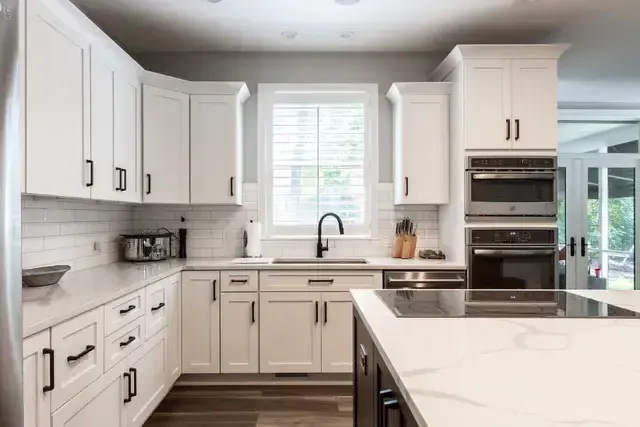
Custom shades measured and installed in FortvillePlantation shutters fitted to a Fortville windowCellular shades in a Fortville living room
Scope of Work

What Wood Blinds Includes

Every Fortville job is documented item by item. Here is what the crew covers.

Room-by-room check that every opening stays conditioned all year before wood goes onto the order

Wet rooms ruled out in writing, because a bath or a window over a sink is a faux wood job

Three widths and three heights per opening, plus a diagonal check for square

Mounting depth measured so the headrail sits fully inside the opening where an inside mount is wanted

Basswood specified as the working standard, with heavier species used only where the grain has to carry a room

Slat size chosen against the opening height and the weight of the existing casing

Wider single spans priced without a support bracket, since wood weighs less per foot than composite does

Stain or paint matched from a physical sample held against your actual trim in your actual light

Grain variation and color drift across a stained order explained before anything gets signed

Cloth tape ladders selected where a woven band suits the room and hides the route holes

Routeless construction offered where a line of lit holes would bother you at night

Valance profile and return depth chosen to sit correctly against existing millwork

Wand tilt set as the default, with cord tilt only where a wand fouls a handle or a return

Cordless lift specified in bedrooms, stairwells and any room children use

Products specified to conform to ANSI/WCMA A100.1-2022 for cord access

Light gap per side disclosed at the measure and carried onto the paperwork

Written contract with scope, dates and total price, as IC 24-5-11 requires on residential work over $150

Slats leveled and both full tilt travel and full lift travel tested at every window on install day

Pricing

What Wood Blinds Cost in Fortville

Published national figures for the category put stock blinds and shades near $60 to $600 a window, with custom-fabricated product running roughly $250 to $2,600. Those are national ranges and they aren't a quote for a house in Fortville. Real wood sits above faux wood in that band and it should, because you're paying for a milled hardwood slat and a finish that has to look right next to your existing trim. Size drives the number first. After that it's the finish: a stock stain costs less than a color matched to millwork, and a matched finish sometimes means a sample run before production. Cloth tapes, a deco valance and routeless slats each add. Fortville Window Treatments prices from measured openings in Hancock County, never from an average.

By Product

How Wood Blinds Differ by Product

Every product in this trade behaves differently in a room. Here is what that means for this work.

2 inch basswood slat: Our working standard in real wood. Basswood is light for its stiffness, which is exactly what you want in a lift mechanism, and the 2 inch slat suits the openings and the casing we find in most central Indiana houses.

2 1/2 inch basswood slat: The same species with a wider face, so fewer slats cross the opening and the view out improves when they're tilted open. It suits taller windows and rooms with substantial casing, where a narrow slat starts to look busy against the trim.

Heavier hardwood species: Some lines offer denser woods that take a stain with more figure than basswood shows. They cost more and they weigh more, so we reserve them for a room where the blind is meant to be looked at rather than looked through.

Stained finish: A transparent finish that lets grain read through, which is the reason to buy wood at all. Expect variation from slat to slat, because that's the wood talking. We hold a physical sample against your trim before committing anything to an order.

Painted finish: An opaque finish in white or an off-white, which gives you wood's light weight and a face that reads as painted millwork. It's the right call when the blind should disappear into the trim instead of standing apart from it.

Custom color match: The factory matches a finish to a sample you supply, usually a piece of your casing or a stair part. It adds cost and time, sometimes a sample run before production, and it's the only honest way to hit an existing stain.

Cloth tape ladders: A woven tape running down the face of the blind that covers the route holes and adds a color band. On a stained wood blind it's a strong design move, and it narrows the view a little wherever a tape crosses the slats.

Routeless wood slats: The lift cord sits in a notch at the back edge instead of a punched hole, so a closed blind has no line of bright dots across it. In a bedroom with a streetlight outside, that's the difference people actually notice.

Crown or deco valance: A shaped valance with a deeper face than the standard flat one, meant to read as trim rather than as a cover for hardware. Choose it where the casing is heavy enough that a plain valance would look thin against it.

Cordless lift: A constant-force spring in the headrail with no lift cord on the blind at all. Wood's lower weight makes cordless feel better here than it does on composite, and it's what we put in bedrooms and anywhere along a stairwell.

Common Questions

Wood Blinds FAQ

Questions we hear most often from Fortville homeowners considering wood blinds.

We can get close on a sample and we'd rather show you than promise. Original trim in the 1849 plat is a hundred and forty years of finish, sun and hand oil on top of whatever species the carpenter had, and a factory stain on basswood starts from a different place. We bring the stain cards to the house and hold them on the actual trim, in the room, at the time of day you use it. Sometimes the honest answer is that a painted blind in the wall color disappears better than a near miss stain does. On Merrill Street and Pearl Street we've gone both ways for good reasons.
Three places, and we'll tell you before you order. Over a kitchen sink, because steam is constant and basswood answers by cupping. In a small bathroom without strong ventilation, for the same reason. And on a west facing wall in the Geist facing plats, where afternoon light comes in direct and again off the water, because stain shifts under that load and a wood slat has no protection from it. Everywhere else, wood is the better looking product and the lighter one. For those three rooms we'd point you at faux wood, which is dimensionally stable and costs less besides.
They fit well, and they suit them. Those openings run tall with high head heights, so a 2 inch slat keeps the proportions right where a wider slat would look chunky. The catch is depth. Storm window build ups are common on the original wood windows here and they can quietly remove an inch and a half of mounting depth without being obvious from inside the room. We measure the depth at the stop before we commit to an inside mount. Where a build up eats the space, an outside mount on the casing works, and on molded casing it can look more finished than a tight inside fit.
Enough that it changes what you can hang. Basswood is meaningfully lighter than PVC at the same slat size, so a wood blind can span a wider opening before the lift gets heavy and before the middle sags. That matters on the wide front picture windows of the 1960s ranches in the State Street grid, and it matters on any two story stair window. It also matters for a cordless lift, which has to be tuned to the weight of the blind. If you're covering a run of large openings and want one product across all of them, wood usually gives you a cleaner result.
It takes the worst conditions in the house. Upper rooms in the 1849 plat and the State Street grid can sit well above the July average high of 85.2 degrees, and warm humid air is exactly what makes a slat move. If that describes your second floor, say so at the measure. We'd specify faux wood upstairs and keep real wood on the main level, which is a split people resist until they see the stain match holds anyway because the two floors are rarely seen together. Mixing products by room is normal here and nobody walking through notices.
The product standard to ask about is ANSI/WCMA A100.1-2022, which applies to the product rather than to any company, and the honest route is a cordless lift with a wand tilt so there's no operating cord in the room at all. Fortville runs 2.7 persons per household, the highest of the places we cover, and Fortville Elementary School sits inside the older grid, so a lot of these houses have young children in them. We specify cordless as the default on anything below adult reach and we'll tell you when a wide or tall blind gets heavy enough that a cordless lift stops feeling pleasant to use.
Because wood answers moisture by moving, and a bathroom gives it plenty to answer. A slat that takes on humidity swells slightly across its width, then gives that moisture back when the room dries out, and after enough cycles it doesn't come back straight. You get cupping along the slat and a blind that stops closing evenly. Faux wood has no fiber left to swell, so it does that job instead. In a white blind, from across the room, you'd have a hard time telling which is which anyway.
It runs it through two opposite conditions. The muggy stretch here goes from late May into late September, so a wood slat spends about four months taking on humidity. Then the heat comes on, indoor air gets dry, and the same slat gives that moisture back over a heated winter. In a conditioned room that cycle is mild and the blind is fine for years. In a room that swings, a sunroom or an unconditioned porch, it's the cycle that eventually takes a slat out of flat.
For most of what we hang, yes. Basswood is stable, mills cleanly, and it's light for its stiffness, which matters more than people expect. Weight is what a lift mechanism fights, and a lighter slat means a wider blind can work as one unit and a cordless lift feels smoother in the hand. Denser species exist and they show more figure under a stain, but they cost more and they add weight. We use them where a room is really about the look of the wood.
Usually close, sometimes exactly, and never from a screen. We bring physical samples and hold them against your casing in the light that room actually gets, because a stain that looks right under a showroom lamp can read orange at four in the afternoon. If nothing in the standard range lands, a custom color match sends a sample of your trim to the factory. That adds cost and time. It's also the only method that gets you there, so we'd rather quote it honestly up front.
Because it's wood. Grain runs differently through each piece, stain sits into open grain more heavily than into tight grain, and a slat cut from one part of a board takes color a little differently from its neighbor. On a stained blind that variation is the product working as intended, not a fault. If you want a face with no variation at all, a painted wood blind or a composite slat is the honest way to get it, and we'll say so before you order.
Wood is fine there as long as the room stays conditioned, which a living room does. What you should know is that a stained wood slat sitting in direct afternoon sun will lighten over years, and it lightens on the sun side more than the shaded side, so a wide window can end up reading unevenly. NFRC puts UV at roughly 40 to 60 percent of fading damage. Tilting the slats up bounces the direct sun toward the ceiling and slows the change. It doesn't halt it.
Wider than the same blind in composite, which is one of the practical arguments for wood. Every manufacturer publishes a maximum width and a maximum square footage, and those limits are really weight limits. Basswood weighs less per running foot than a faux wood slat of the same size, so a span that would want a center support bracket or a two-on-one headrail in composite can often stay a single unit in wood. We check the actual numbers against your measured opening before ordering.
They're woven tapes that run vertically down the face of the blind, covering the route holes and carrying a color band. Mechanically almost nothing changes, since the ladder still holds the slats and the lift still runs the same way. What changes is the look, quite a lot, and the view, slightly, because each tape sits across the slats and blocks a narrow strip when they're open. Frayed tapes on an old blind are one of the common reasons people replace an otherwise working unit.
On a tall window the wider slat usually wins. Fewer slats cross the opening, the face reads calmer, and the view between open slats is better, which matters more the more window there is. The 2 1/2 inch slat also suits heavier casing, and older houses in Fortville often have casing worth respecting. Where we go back to 2 inch is a short window, a transom or a room with delicate trim, since a wide slat there swamps the opening it's sitting in.
They slow it, and that's the accurate word. NFRC attributes roughly 40 to 60 percent of fading damage to UV, with the rest coming from visible light and heat, so no window covering ends the problem outright. A closed wood blind is an opaque layer, which does more than a sheer fabric, and tilting the slats upward on a sunny afternoon keeps direct sun off a hardwood floor while the room stays usable. That's a real reduction in exposure rather than an end to it.
You can order more, and you should expect a small difference. Stain lots vary, wood varies, and a blind built next year comes from different boards than the ones hanging now. Across a hallway nobody sees it. On two windows in the same wall it's obvious. The practical answer is to order a room complete rather than half of it, even where a window seems low priority. We write the exact finish name onto your paperwork so a later order at least starts from the right reference.
Dry first, always. Close the slats one direction, run a dry microfiber cloth or a vacuum brush across the face, then close them the other way and repeat. For a mark that won't dust off, use a barely damp cloth and dry it immediately. Don't soak a slat, don't use a spray cleaner across the whole blind, and never put a wood blind in water the way people sometimes do with vinyl. Cloth tapes want a soft brush rather than anything wet.
In a bedroom or along a stairwell, yes. There's no lift cord on the product at all, which is the direction the ANSI/WCMA A100.1-2022 work on cord access points, and inner-cord non-compliance is treated as a substantial product hazard under 16 CFR 1120.3. Beyond that, a cordless wood blind is simply nicer to use every day, and wood's lighter weight makes the mechanism feel smoother than it does on a heavy composite unit. On very wide blinds we still talk through whether motorization is the better answer.
Custom fabrication runs two to five weeks in this trade, and stained wood tends toward the longer end because finishing is a separate step at the factory. A custom color match adds more, sometimes a sample run before production even starts. None of that is a delay. It's a factory milling and finishing slats to sizes taken in your house. You'll get the window in writing with scope, dates and total price, which the Indiana Home Improvement Contract Act requires on residential work over $150.
Free In-Home Measure

Schedule Your Free In-Home Measure in Fortville

Contact Information

Reach Us Directly

Our team prioritizes scheduled measures and service calls, and books in-home measures during business hours.

Office
1417 Commerce Avenue, Indianapolis, IN 46201
Hours
Mon-Fri 8a-6p
Service Area
Fortville, IN and Surrounding Areas

Ready to Book Your Measure?

Call us to set up an in-home measure, or to ask about a treatment that has stopped working. We will talk it through on the phone first.

Service area

Serving Fortville and the surrounding area

Call NowGet Quote